Punchlines as Medicine: The Indigenous Comedians Turning Pain Into Power One Joke at a Time
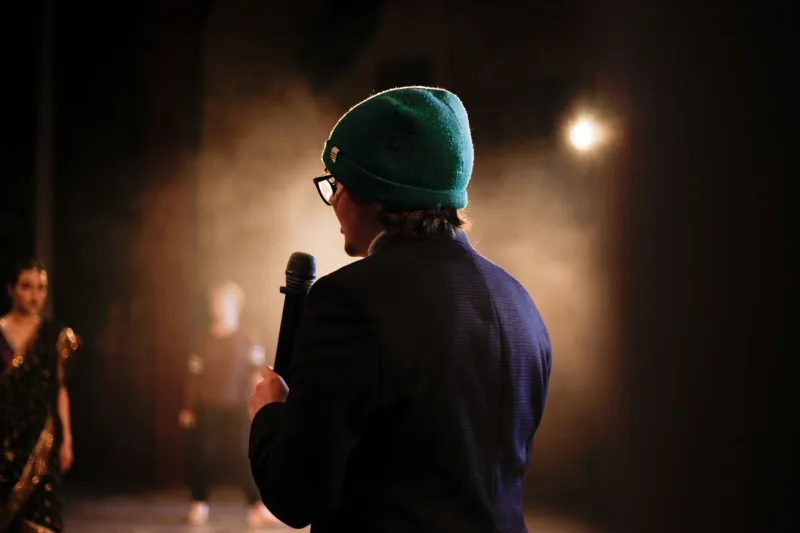
There's a moment in a lot of Indigenous comedy sets — you can feel it in the room — where the laughter shifts. It starts loose and warm, the kind of chuckling that comes from recognition. Then a punchline lands that hits a little different, a little deeper, and the audience goes somewhere together. Not uncomfortable, exactly. Just awake. Present. Like something real just got said.
That's not an accident. For Native comedians working today, the joke is never just a joke.
The Trickster Never Clocked Out
Long before there were open mics or streaming specials, Indigenous storytelling traditions carried a character who thrived on chaos, contradiction, and uncomfortable truth-telling: the Trickster. Coyote. Raven. Iktomi the Spider. The names shift across nations, but the energy is consistent — a figure who exposes the absurdity of power, who uses mischief to say what polite society won't, and who makes people laugh precisely because the truth is too sharp to deliver any other way.
Modern Indigenous stand-up didn't fall from the sky. It walked out of that tradition, dusted itself off, and got a microphone.
"We've always had our version of comedy," says one Ojibwe comedian who performs regularly in Minneapolis and Chicago. "Grandmas roasting each other at the kitchen table. Elders telling stories that are technically about animals but definitely about your uncle. That's the lineage. I'm just doing it in front of strangers who paid a cover charge."
That lineage matters because it reframes the whole conversation. Indigenous humor isn't a coping mechanism that emerged in response to colonization — though it absolutely adapted to survive it. It's a cultural technology that predates contact, one that was always meant to do heavy lifting.
Making Your People Laugh First
Ask almost any Native comedian who their primary audience is, and the answer comes fast: their community. Not Hollywood. Not the algorithm. Not the non-Native audience member in the third row who's going to Google "what is a frybread" on the way home.
This is a meaningful distinction. A lot of mainstream comedy about marginalized communities gets built outward — designed to explain, to educate, to make outsiders comfortable. Indigenous comedy, at its best, gets built inward first. The jokes assume you already know. They assume shared experience, shared grief, shared absurdity.
A bit about the Indian Health Service waiting room isn't explained to the audience — it's recognized by them. A sketch about being the only Native kid in a suburban school doesn't come with footnotes. The laughter is the footnote.
This inward orientation is also what makes it so disarming when it crosses over. Because when a non-Native audience laughs at a joke built for a Native room, they're not laughing at a caricature. They're catching a glimpse of something real, something they didn't have a frame for before. That's a different kind of education than anything a textbook delivers.
The Digital Stage and the Shift in Power
Social media has genuinely changed the game. Indigenous creators on TikTok, Instagram Reels, and YouTube have built audiences of hundreds of thousands — sometimes millions — without a single TV credit or late-night booking. The gatekeepers who historically controlled which Native voices got amplified (and which got flattened into mascots or mystical sidekicks) have a lot less power than they used to.
Creators are doing rapid-fire character work, political satire, and slice-of-life sketches that rack up comments from both reservation communities and suburban kids who stumbled onto the content through the algorithm. The comment sections are their own kind of cultural exchange — messy, sometimes frustrating, often surprisingly moving.
What's notable is how many of these creators are doing explicitly political work and framing it as comedy. Sketches about land rights, mascot controversies, blood quantum debates, and the particular exhaustion of being asked to speak for an entire people — these aren't softened for palatability. They're sharp. They trust the audience to keep up.
"Comedy gives you permission to go places that a think piece can't," one Cherokee comedian and content creator explained in a recent interview. "People share a funny video. They don't always share an op-ed. So the reach is different. And once they're laughing, they're also thinking. You got them."
Processing What Doesn't Have a Clean Name
Intergenerational trauma is a clinical term for something that lives in the body, in family dynamics, in the way certain silences feel at the dinner table. Indigenous communities carry an enormous weight of it — boarding school legacies, forced relocation, the ongoing violence of systemic neglect. That's not abstract history. It's present tense for millions of people.
Humor has always been one of the ways communities metabolize what can't be processed cleanly. Laughing at the thing doesn't minimize it — sometimes it's the only way to look directly at it without flinching. Native comedians are doing that work in public, which takes a particular kind of courage.
A joke about the federal government's track record with treaty obligations isn't just a punchline. It's an acknowledgment, a release valve, and a call to attention all at once. The audience laughs because the absurdity is real. And then they sit with it.
This is where comedy becomes something closer to medicine — not in a soft, metaphorical way, but in a functional one. Laughter shared in community builds connection. It signals that the thing you've been carrying quietly is actually known, is seen, is survivable enough to joke about. That's not nothing. That's a lot.
The Mainstream Is Listening — Now What?
There's growing interest from mainstream comedy institutions in Indigenous voices, and that comes with the usual complicated feelings. Representation on bigger stages matters. So does the question of what gets asked of comedians once they're there — whether they're expected to perform as educators, as ambassadors, as proof-of-concept for some network executive's diversity initiative.
The comedians navigating this most successfully seem to be the ones who refuse to adjust their material for the room. They bring the joke they'd tell in their own community and let the mainstream audience catch up. That's a power move dressed as a punchline.
And increasingly, audiences are catching up. The appetite for comedy that's actually rooted in something — in real history, real experience, real stakes — is real. People are tired of jokes that don't mean anything. Indigenous comedy, by its nature, means something.
Laughter as Legacy
At Taupi Heritage, we talk a lot about culture that's alive — not preserved behind glass, not frozen in a textbook version of what Native life is supposed to look like, but living and changing and showing up in unexpected places. Indigenous comedy is exactly that.
It's the Trickster with Wi-Fi. It's the elder's kitchen table story with a comment section. It's centuries of knowing that laughter, wielded right, is one of the sharpest tools a community has.
Next time you see a Native comedian on a stage or a screen, pay attention to what the room does when the punchline lands. That collective exhale, that shared recognition — that's culture doing what it's always done. Surviving. Connecting. Refusing to be quiet about any of it.
And doing it, somehow, while making you laugh.