Healing Outside the Hour: Why Indigenous Mental Health Practices Are Exposing the Limits of Western Therapy
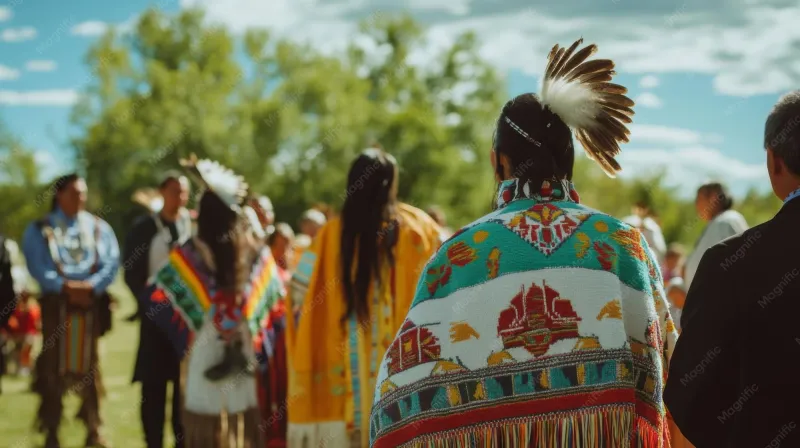
Photo: Indigenous healing circle community gathering outdoor ceremony, via img.freepik.com
Let's be honest about what the standard American mental health system actually is. You sit in a beige room for fifty minutes. You talk to a stranger who takes notes. You pay — or fight with your insurance company — and you come back next week and do it again. The stranger is trained, credentialed, and well-intentioned. But they are, structurally, a service provider. You are a client. The relationship begins and ends at the door.
For millions of Americans, this model has been genuinely helpful. I'm not here to dismiss that. But for Indigenous communities — communities that have experienced collective trauma on a scale that Western psychology barely has language for — the fifty-minute hour was never going to be enough. And a growing movement of Native healers, counselors, and community practitioners is proving it.
They're not just offering an alternative. They're exposing a set of assumptions so baked into Western therapeutic practice that most clinicians don't even know they're making them.
The Myth of the Individual Patient
Western psychology, at its core, is built around the individual. The diagnosis belongs to one person. The treatment plan is tailored to one person. The healing, ultimately, is supposed to happen inside one person's head.
Indigenous healing frameworks almost universally reject this premise — not as a philosophical stance, but as a practical observation about how human beings actually work.
"You cannot heal a person in isolation from their family, their community, their land, their ancestors," says Dr. Maria Yellow Horse Brave Heart, a Lakota social worker and researcher whose work on historical trauma has been transformative for the field. "The wound is not just individual. The healing cannot be either."
This is why the healing circle — in its many variations across different nations and traditions — looks so foreign to Western clinical eyes. It's not a group therapy session with a facilitator. It's a community taking collective responsibility for the wellbeing of its members. The accountability flows in every direction. The healing is something that happens between people, not inside them.
And here's what the research is starting to confirm: it works. Studies on restorative circle practices in Indigenous communities have documented reductions in substance use, improvements in youth mental health outcomes, and decreases in community violence — in contexts where conventional clinical interventions had limited effect.
The Therapy-Industrial Complex Has a Business Model Problem
This is the part that doesn't get said enough in polite mental health discussions: the Western therapy system is also an economic system, and its economic logic shapes what it considers valid treatment.
Insurance companies reimburse for individual sessions with credentialed providers. They don't reimburse for a ceremony. They don't reimburse for an elder spending three days with a grieving family. They don't reimburse for the kind of sustained community presence that actually addresses the social determinants of mental health — poverty, isolation, disconnection from culture and land.
So those things don't happen, not at scale, not with institutional support. And the communities that need them most — rural Native communities, urban Indigenous populations scattered across cities like Minneapolis, Phoenix, and Los Angeles — are left with a system that was never designed for them and has repeatedly failed to serve them.
The Indian Health Service, the federal agency responsible for healthcare in Native communities, spends roughly a third of what it costs to provide comparable care to the general population. Mental health services are chronically understaffed and underfunded. The crisis is not a secret. It's been documented for decades.
What's new is the response.
Building Something Else Entirely
Across the country, Native practitioners are not waiting for the system to fix itself. They're building parallel infrastructure.
In Minnesota, the White Earth Nation has developed a community wellness program that integrates traditional Anishinaabe healing practices with clinical mental health support — not as an add-on, but as a co-equal framework. Elders and licensed counselors work in the same space, with explicit acknowledgment that both knowledge systems have something essential to contribute.
In New Mexico, the Zuni Pueblo has long maintained a community-based behavioral health system that centers cultural identity and spiritual practice as primary therapeutic tools. Their youth suicide prevention work, which incorporates traditional coming-of-age practices alongside clinical intervention, has been cited as a model by the Substance Abuse and Mental Health Services Administration.
In urban centers, organizations like the Native American Health Center in Oakland and the American Indian Community House in New York City are providing care that meets people where they are — culturally, geographically, and economically — in ways that standard outpatient clinics simply don't.
What "Balance" Actually Means as a Clinical Framework
One of the most consistent concepts across Indigenous healing traditions is balance — not as a vague aspiration but as a specific diagnostic and therapeutic framework. Illness, whether physical or emotional, is understood as a disruption of balance: between a person and their community, between humans and the natural world, between the living and the ancestors.
Restoring balance requires addressing all of those dimensions. It's not enough to treat the symptom. You have to understand the disruption.
This is actually not that far from where the cutting edge of Western psychology is heading. Trauma-informed care, somatic therapy, ecological psychology, community-based participatory research — all of these represent Western clinical practice slowly rediscovering things that Indigenous healing traditions have held for centuries.
"We're not asking Western psychology to validate us," says one Native counselor working in the Pacific Northwest. "We're noticing that it keeps arriving at conclusions we already had. That's interesting. But we don't need their arrival to know we were right."
The Question Worth Sitting With
If Indigenous mental health frameworks are producing demonstrable results — and the evidence increasingly suggests they are — then the relevant question isn't whether they "count" as legitimate treatment. The question is why it's taken this long for institutions to take them seriously, and what it would actually cost to resource them properly.
The answer to that second question involves money, yes. But it also involves power. It involves acknowledging that the expertise doesn't always live in the clinic. Sometimes it lives in the circle. Sometimes it lives in the elder who knows which story to tell and when to tell it. Sometimes healing is not an appointment. It's a relationship, extended over time, held by a community that has decided no one heals alone.
That's not a supplement to the mental health system. For a lot of people, it's the whole thing.