Roots, Remedies, and Revenue: Indigenous Wellness Practitioners Are Turning Ancestral Knowledge Into Thriving Livelihoods
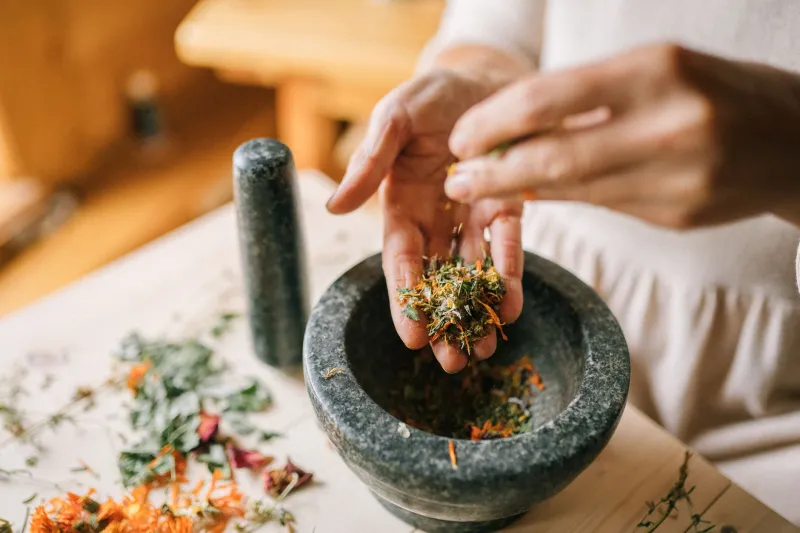
Walk into almost any mainstream wellness market in America right now and you'll find Indigenous plant knowledge — stripped of its context, repackaged in minimalist branding, and sold at a markup to consumers who have no idea where it came from. Sage. Cedar. Sweetgrass. Elderberry. Medicines that Native communities have stewarded for thousands of years now move billions of dollars through an industry that rarely names its sources and almost never shares the profits.
But something else is happening at the same time, quieter and more meaningful. Indigenous healers and wellness practitioners across the country are building their own enterprises — on their own terms, rooted in their own values — and they are doing it without surrendering the spiritual integrity that makes their work matter in the first place.
What Traditional Medicine Actually Is
Before getting into the economics, it's worth being clear about something that often gets muddled in wellness industry conversations: traditional Indigenous medicine is not a collection of herbal remedies that happen to be old. It is a comprehensive system of understanding health, illness, community, and the natural world — one that integrates physical treatment with spiritual practice, relational accountability, and deep ecological knowledge.
"People come to me wanting to buy the plant," says Teresa Morningstar, a Cherokee herbalist and wellness practitioner based in western North Carolina. "But the plant doesn't work the same way outside of the relationship. Outside of the prayer, the protocol, the intention. That's not mysticism — that's just how it works."
This distinction matters enormously for understanding both the promise and the peril of building businesses around traditional medicine. The most successful Indigenous wellness practitioners are the ones who have figured out how to create economic value without reducing their practice to a product catalog.
The Appropriation Problem Is Real — and So Is the Solution
The commercialization of Indigenous wellness practices by non-Native businesses is not a new problem, but it has intensified dramatically as the American wellness industry has ballooned into a nearly $500 billion market. Smudge kits sold at Urban Outfitters. "Shamanic" healing retreats run by people who spent a weekend at a workshop. Crystal healing traditions lifted wholesale from Lakota and Diné cosmologies without acknowledgment or compensation.
The harm isn't just economic, though the economic harm is real. Appropriation distorts practices, strips them of meaning, and can actively interfere with the ability of communities to maintain their own relationships to their medicines and ceremonies.
But the answer, many Indigenous practitioners argue, is not to wall off traditional knowledge from the economy entirely. It's to build an Indigenous-led wellness economy that can compete, educate, and set the terms.
"If someone is going to spend money on sage, I want them spending it with me," says Marcus Twohawks, a Lakota herbalist and entrepreneur who runs a small-batch botanical business from his home community in South Dakota. "And when they buy from me, they get the story. They get the context. They get educated about what this plant actually means and where it comes from. That's not just better for them — it's protective for us."
Building a Business Without Losing the Medicine
The practical challenges of building an Indigenous wellness business are formidable. Access to capital is limited — Native entrepreneurs face some of the highest rates of loan denial of any demographic in the country. Distribution networks are often controlled by companies with no interest in amplifying Indigenous voices. And the wellness market is crowded with well-funded competitors who have no compunctions about borrowing whatever they find useful from Indigenous traditions.
Despite all of this, a growing number of practitioners are finding their footing.
Morningstar has built a practice that combines one-on-one consultations, workshops on Cherokee plant medicine for community members, and a small line of ethically sourced herbal preparations that she sells through her own website and at local markets. She is careful about what she sells and what she keeps out of commerce entirely.
"There are things I do in ceremony that will never be a product," she says flatly. "But there are also things I know — about plants, about how to use them, about how to build a relationship with the natural world — that I can share, and that sharing can support my family and my work. Those are different categories and I keep them very separate."
Twohawks has found success partly through storytelling. His product packaging includes QR codes linking to audio recordings of elders talking about the plants being sold — their histories, their protocols, their relationships to specific places and seasons. It's a model that adds value while actively educating consumers about the depth of what they're engaging with.
Community Accountability as a Business Model
One of the most interesting features of the Indigenous wellness economy is the role that community accountability plays as both an ethical constraint and a practical competitive advantage.
Many practitioners operate within formal or informal community oversight structures that govern how traditional knowledge can be used commercially. These aren't just cultural niceties — they are genuine checks on the commercialization impulse that can otherwise erode the integrity of a practice over time.
"My community knows what I do," says Morningstar. "Elders know what I sell and what I don't sell. If I started crossing lines, I would hear about it. That accountability is not a burden — it's what keeps me honest and it's what keeps my work real."
This kind of built-in accountability is something mainstream wellness brands spend millions trying to simulate through advisory boards, certification schemes, and purpose statements. For Indigenous practitioners operating within living community relationships, it comes standard.
The Bigger Picture: Wellness as Economic Sovereignty
Zoom out from any individual practitioner's story and a larger pattern comes into focus. The Indigenous wellness economy is not just about individual livelihoods — it is part of a broader project of economic self-determination that connects to land stewardship, language preservation, and community health in ways that are deeply intertwined.
When an Indigenous herbalist builds a sustainable business, she is also maintaining a relationship with specific plants on specific lands — a relationship that carries ecological knowledge, cultural memory, and community responsibility. When she educates her customers, she is doing cultural work. When she employs community members in her harvest and production process, she is building local economic infrastructure.
None of this is incidental. It is, in the best examples, exactly the point.
"My grandmother never called what she did a business," says Twohawks. "She called it taking care of people. I'm trying to take care of people too. It just turns out that in this economy, you have to build something sustainable to keep doing that. So that's what I'm building."