What the Classroom Never Taught You: Inside Indigenous Mentorship Networks Rewriting the Rules of Knowledge
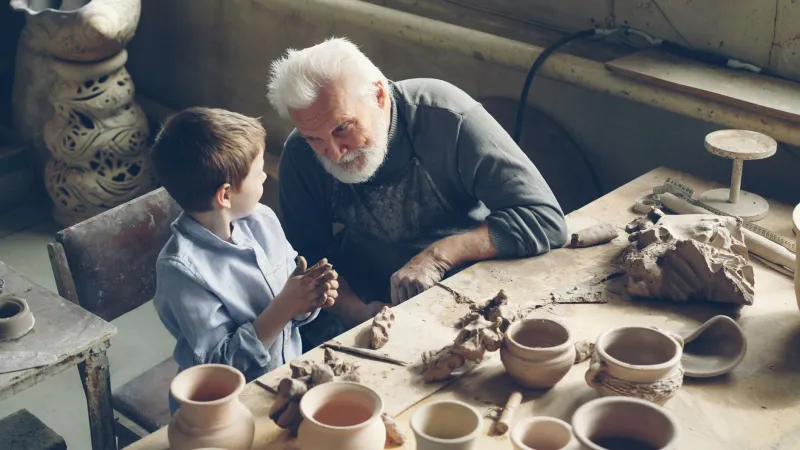
There's a kind of knowledge that doesn't live in a textbook. It doesn't have a standardized test, a rubric, or a semester deadline. It lives in the hands of an elder demonstrating a drum-making technique she learned from her grandmother. It lives in the patient correction of a master carver guiding a teenager's chisel for the hundredth time. And increasingly, it lives in Zoom calls between Indigenous engineers in Silicon Valley and high school students on reservations who have never once seen themselves reflected in a career day brochure.
Across the United States, Indigenous communities are running some of the most sophisticated knowledge-transfer systems in the country — and most of the world has no idea.
The Original Apprenticeship
Before universities, before trade schools, before any institution handed out a credential, Indigenous communities had mentorship. It was the architecture of cultural survival. A young Diné weaver didn't read about warp and weft — she sat beside her aunt for years, watching, asking, making mistakes, and learning what the loom had to say. A Lakota hunter didn't study wildlife biology in a lecture hall — he learned to read the land from the men who had read it before him.
That model never disappeared. It adapted.
"People act like what we're doing is some kind of innovation," says Marlena Swiftwind, a master beadworker and cultural educator based in Rapid City, South Dakota, who runs an apprenticeship program connecting young Oglala Lakota artists with established craftspeople. "We're just doing what our communities have always done. We pass things down. That's not a program — that's a way of life."
What has changed is the intentionality around documenting, funding, and expanding these systems. Organizations like the First Nations Development Institute and the Notah Begay III Foundation have spent years investing in community-based mentorship infrastructure, recognizing that cultural continuity and economic mobility are not separate goals — they are the same goal.
STEM, Sovereignty, and Someone Who Looks Like You
The mentorship conversation has grown well beyond traditional arts. One of the most exciting developments in Indian Country right now is the explosion of Indigenous professional networks in science, technology, engineering, and mathematics — fields where Native representation has historically been almost invisible.
SACNAS, the Society for Advancement of Chicanos/Hispanics and Native Americans in Science, has long served as a professional lifeline for Indigenous scientists navigating institutions that were never built for them. But what's happening at the community level is something different and arguably more powerful: informal networks of Indigenous engineers, doctors, lawyers, and entrepreneurs who are deliberately reaching back.
Take the work happening through groups like the American Indian Science and Engineering Society (AISES), which runs mentorship pipelines connecting Indigenous college students with Native professionals. The message isn't just "here's how to get a job." It's "here's how to bring your whole self into a career without losing who you are."
"My mentor was the first Native woman I'd ever met who was also a software engineer," recalls one participant in an AISES mentorship cohort from the Pacific Northwest. "She didn't just teach me how to interview. She taught me how to walk into a room full of people who don't understand my background and still know my value."
That kind of transmission — of confidence, of cultural grounding, of professional navigation — is something no university orientation can manufacture.
The Structure Underneath the Relationship
What makes Indigenous mentorship networks distinct isn't just their cultural content. It's their underlying logic. Where mainstream professional mentorship tends to be transactional — you give me your time, I give you my network — Indigenous mentorship models are built around reciprocity as a living principle.
The expectation isn't just that a mentee will eventually "pay it forward" in some abstract future sense. The relationship itself is understood as a mutual exchange from day one. Elders learn from young people. Practitioners gain new perspectives from apprentices. The knowledge flows in multiple directions simultaneously.
"In our tradition, teaching isn't something you do to someone," explains Raymond Eagleheart, a cultural programs coordinator for a tribal college in Montana. "It's something you do with someone. The elder is changed by the relationship too. That's the whole point."
This philosophy has practical implications. Programs built on Indigenous mentorship values tend to have dramatically lower dropout rates than conventional professional development pipelines. Participants report higher levels of belonging, accountability, and long-term commitment to giving back to their communities.
When Institutions Finally Pay Attention
Mainstream educational institutions are starting to notice — even if they don't always understand what they're seeing.
Several universities have begun formal partnerships with tribal colleges specifically to study community-based mentorship models. Some K-12 school districts in states with significant Indigenous populations — New Mexico, Montana, Oklahoma, South Dakota — have started integrating cultural mentorship components into their career readiness programs, with tribal elders and community knowledge-keepers invited into school spaces as legitimate educators.
The results, where these programs are implemented thoughtfully and led by Indigenous community members themselves, have been striking. Students who participate in culturally grounded mentorship show measurable improvements not just in academic engagement but in what researchers are calling "cultural identity strength" — a sense of pride and groundedness in who they are that turns out to be one of the most reliable predictors of long-term wellbeing.
But community leaders are quick to offer a word of caution about the institutional interest.
"We welcome the partnership, but we need to be the ones driving it," says Swiftwind. "The moment this becomes something a school district owns and controls, it stops being what it is. The power of this is that it belongs to us. It lives in our relationships, not in their curriculum frameworks."
The Knowledge That Can't Be Extracted
Perhaps the most important thing to understand about Indigenous mentorship networks is what they protect by their very nature. Unlike a classroom lesson that can be recorded, packaged, and sold, the knowledge transmitted through deep mentorship relationships is inherently relational. It cannot be extracted from the community that produces it.
You cannot download the experience of sitting beside a master jeweler in Albuquerque for three years and learning not just her technique but her philosophy, her humor, her relationship to the materials she works with. You cannot replicate in a corporate training module the feeling of being seen and recognized by someone who shares your history and believes in your future.
That irreducibility is not a limitation. It is a feature. It is, in fact, the whole point.
In a world drowning in content and starving for connection, Indigenous mentorship networks are offering something genuinely rare: a model of education built around human relationship as its primary technology. No algorithm required.